How to identify asbestos in a Quebec house
The short answer is that you cannot identify it by eye. No serious professional will tell you otherwise. What we do know very well is where to look and from which year to be cautious, and that is already most of the work.
The 1990 rule
In Quebec the practical rule professionals use is simple. Any building built or renovated before 1990 should be treated as potentially containing asbestos, until analysis proves otherwise.
That does not mean every pre 1990 house contains it. It means you have to check before any work that will drill, saw, scrape or demolish, because that disturbance is what releases the fibres.
The six places it hides most often
Joint compounds on drywall partitions. By far the most widespread in Quebec housing, and the most often missed because it is invisible under paint.
Vinyl floor tiles, and above all the black adhesive beneath them. Many owners test the tile and not the adhesive, when it is often the adhesive that comes back positive.
Loose fill vermiculite in attics and wall cavities. Zonolite type vermiculite is presumed to contain asbestos and should never be handled without precautions.
Pipe lagging in basements and mechanical rooms, especially around old boilers. Those are friable materials, so high risk.
Renders, stucco and decorative plasters, notably textured stucco ceilings.
Fibre cement materials, panels, ventilation ducts, drain pipes and exterior shingles.
Friable or non friable, the distinction that changes everything
A friable material can be crumbled to powder by hand. Sprayed insulation, pipe lagging and vermiculite fall in this category and release fibres very easily. Their removal falls under the heavy procedure, with sealed containment, negative pressure and air clearance testing.
A non friable material, like an intact vinyl tile or fibre cement panel, holds its fibres as long as it is not attacked. Removal is far cheaper, but it becomes dangerous the moment it is broken, sanded or sawn.
That is why abatement costs vary so much. It is not the area that governs, it is the nature of the material and the associated risk level.
What you must not do
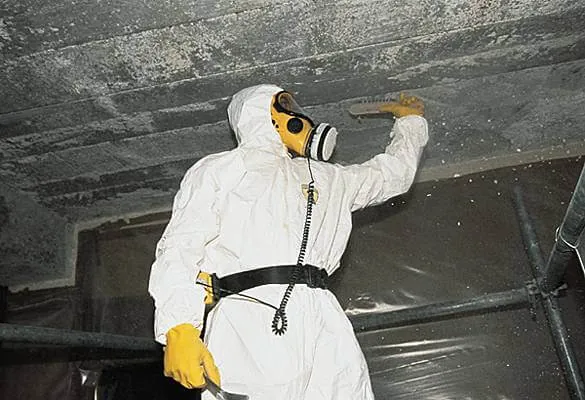
Do not sand, saw or dry sweep a suspect material. Do not remove attic vermiculite yourself. Do not run a household vacuum over suspect debris, an ordinary vacuum disperses fibres rather than trapping them.
If the material is in good condition and you do not touch it, the risk is low. The danger starts with the work, not with the presence.
Getting it tested, in practice
A sample is taken from each suspect material and analysed by an accredited laboratory. Results generally take three to seven days. They state the presence or absence of asbestos and the fibre type.
That report then determines the working method, the containment level and the price. It is also among the documents insurers, notaries and buyers ask for during a transaction.
Frequently asked questions
Taking the sample is itself a risky operation, because it disturbs the material. It has to be done with proper protection and by a method that does not contaminate the room. We have samples taken and analysed by an accredited laboratory, which also produces a report that stands up in a transaction or a dispute.
Generally three to seven days between sampling and the laboratory report. That is the delay to anticipate before a job, because no work should start before the result.
No. Asbestos containing material in good condition and undisturbed can stay in place under monitoring. Removal becomes necessary when work will disturb it, or when the material deteriorates and releases fibres.