Asbestos abatement in Montréal
Sprayed insulation, pipe lagging, ceiling tiles, joint compounds, floor tile adhesives and vermiculite. Removal under sealed containment in strict compliance with Quebec regulations, from the first sample to the final report.
- RBQ 5835-4499-01 Valid licence
- CNESST certified Standards up to date
- $5M insurance Civil liability
- Quote within 24h Firm price
Why asbestos demands a procedure, not improvisation
Asbestos is only dangerous once it is disturbed. Left in place and intact, it releases nothing. The problem starts the moment you drill, saw, scrape or demolish. Fibres become respirable and stay airborne for hours. That is why the Quebec occupational health and safety regulation frames every step, and why a poorly executed removal contaminates a whole building instead of cleaning one room.
Materials we handle
Sprayed insulation and pipe lagging
Fireproofing sprayed on steel structures and pipe insulation, very common in buildings from before 1980.
Ceiling and floor tiles
Acoustic tiles, vinyl tiles and above all the black adhesive under the tiles, often missed in quick assessments.
Joint compounds and plasters
Drywall joint compound, render and stucco. Widespread in Quebec housing until the late 1980s.
Vermiculite
Loose fill insulation in attics and wall cavities. Zonolite type vermiculite is presumed to contain asbestos.
Asbestos cement
Panels, ventilation ducts, drain pipes and fibre cement shingles.
Gaskets and seals
Boiler gaskets, fire door seals and industrial mechanical system components.
The removal procedure, step by step
Characterisation
Suspect materials sampled and analysed by an accredited laboratory. No work starts before the result is in.
Risk classification
The risk level, low, moderate or high, sets the method, the equipment and the required protections.
Containment
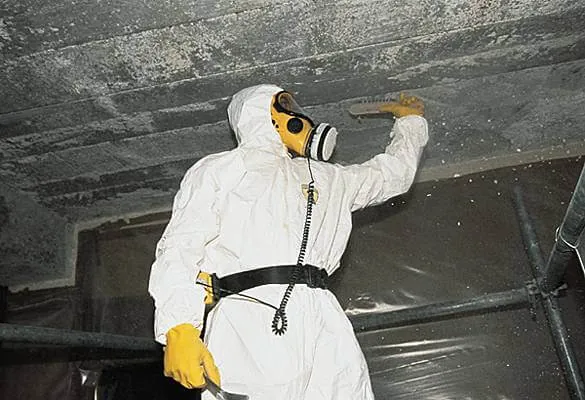
Full isolation of the zone in polyethylene, multi chamber decontamination airlock and continuous negative pressure.
HEPA filtration
High efficiency filtration units that renew the air in the zone and discharge filtered air outside.
Wet removal
Materials are wetted before removal to stop fibres becoming airborne, then double bagged and labelled.
Air clearance and report
Air sampling before the containment comes down, then delivery of the compliance report and disposal manifests.
What drives the price of abatement
Abatement is priced case by case because the procedure changes completely with the material and the risk level.
- Material typeFriable sprayed insulation is high risk and triggers the heavy procedure. A non friable vinyl tile is removed under low risk at a far lower cost.
- Area to be treatedContainment carries a large fixed cost. A small area therefore costs a lot per square foot, a large area far less.
- AccessibilityA low attic or a tight service void slows the work down enormously compared with an open room.
- Keeping the building in useIf the building stays occupied you need reinforced containment, more frequent air testing and often night work.
- Laboratory analysisEvery sample and every air test has a cost. A building with varied materials needs more of them.
- DisposalAsbestos goes to a special waste stream, more expensive than ordinary landfill, with a manifest kept on file.
Everywhere in Greater Montréal.
Travel included in the quote, across the island of Montréal, Laval, the South Shore and the North Shore.
Montréal and Laval
- Montréal
- Saint-Léonard
- Anjou
- Rosemont
- Villeray
- Ahuntsic
- Le Plateau
- Côte-des-Neiges
- Laval
South Shore
- Longueuil
- Brossard
- Boucherville
- Saint-Hubert
- Saint-Lambert
- Saint-Bruno
- Candiac
- La Prairie
North Shore
- Terrebonne
- Repentigny
- Mascouche
- Blainville
- Boisbriand
- Rosemère
- Sainte-Thérèse
- Bois-des-Filion
Asbestos FAQ
You cannot tell by looking. Only accredited laboratory analysis confirms it. The practical rule is simple, any building built or renovated before 1990 in Quebec should be treated as suspect until proven otherwise, and tested before any work that disturbs materials.
Not automatically. Asbestos containing material in good condition and undisturbed can stay in place under monitoring. Removal becomes mandatory as soon as work will disturb it, or when the material deteriorates and releases fibres.
Two to five days for a room or attic at low or moderate risk. One to three weeks for high risk sprayed insulation over a large area. Add three to seven days upfront for laboratory analysis.
Often yes, provided the work zone is properly contained, under negative pressure and separated from occupied areas. For high risk removal inside a dwelling, temporary relocation is generally recommended.
Work stops immediately. We isolate the area, have samples taken and analysed, then resume with the procedure matching the result. Testing before we start is exactly what avoids that costly stoppage.
Yes. You receive the compliance report, the air test results and the disposal manifests. Insurers, notaries and buyers ask for those documents during a property transaction.
What else we do.
Got a project to demolish?
Tell us about your site. Our estimator visits free of charge and issues a firm quote within 24 to 48 hours.