Mold remediation in Montréal
Flooded basements, poorly ventilated attics, walls that water has travelled behind. We remove contaminated materials, dry the structure properly and verify air quality before handing the space back.
- RBQ 5835-4499-01 Valid licence
- CNESST certified Standards up to date
- $5M insurance Civil liability
- Quote within 24h Firm price
Cleaning the surface never solves the problem
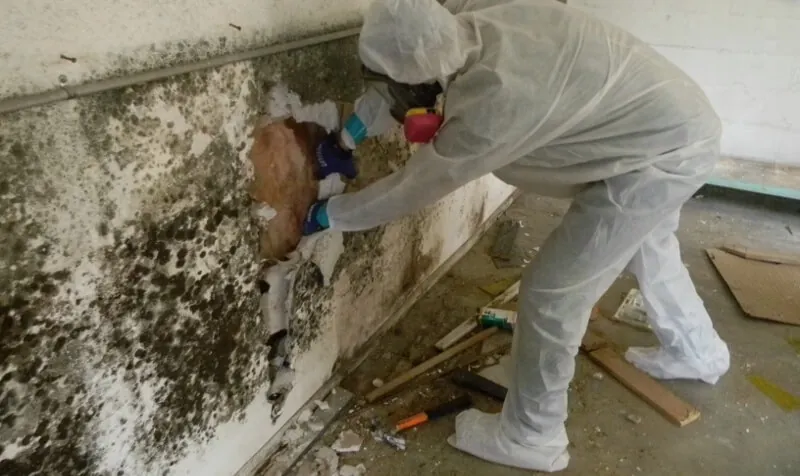
Mold visible on a wall is only the tip. What matters is the moisture source feeding it and the network that has spread through the drywall, the insulation and the structure behind. Wiping bleach on a stain removes the colour for a few weeks, then it all comes back, because nothing was removed and the moisture is still there. Serious remediation therefore always starts by finding where the water comes from.
Where we work
Basements and crawl spaces
Foundation seepage, sewer backup, chronic condensation. The most common zone in Quebec.
Attics and roof spaces
Insufficient ventilation and failed vapour barrier. Mold develops on the roof sheathing.
Exterior walls and behind finishes
Water entry through brick, flashing or caulking. Often invisible until the wall is opened.
Bathrooms and kitchens
Slow leaks under sinks, around bathtubs and behind tile.
After water damage
Backups, burst pipes, flooding. The faster the response, the less the contamination spreads.
Commercial and rental buildings
Rented units, apartment buildings and commercial premises, with the documented file insurers require.
Our remediation protocol
Finding the source
Moisture readings, thermal camera where needed, tracing the water path. Without this step everything else is pointless.
Sampling and initial air test
Sampling to measure the fungal load and document the starting condition.
Zone containment
Polyethylene isolation and negative pressure to stop spores migrating into the rest of the building.
Removal of contaminated materials
Drywall, insulation, affected timber. Anything porous and contaminated comes out, we do not try to save it.
Drying and treatment
Industrial dehumidifiers until moisture returns to normal, then application of a certified antifungal product.
Final air test
New measurement compared against outdoor air. Results are provided to you in writing.
What drives the price
Cost depends above all on the real extent of the contamination, which is almost always wider than what is visible.
- Contaminated areaUnder one square metre often calls for simple cleaning. Beyond ten square metres, the full protocol with containment applies.
- Depth of penetrationSurface mold on concrete can be cleaned. Mold in insulation and structure requires full removal.
- The cause to be fixedOur remediation does not repair the foundation or roof letting water in. That repair still has to be planned, otherwise the mold returns.
- Drying timeA saturated structure can need several days of dehumidification, with equipment staying on site.
- Number of air testsOne initial and one final test at minimum, more on larger sites or where there is a dispute.
- OccupancyAn occupied dwelling requires stricter containment and phased planning.
Everywhere in Greater Montréal.
Travel included in the quote, across the island of Montréal, Laval, the South Shore and the North Shore.
Montréal and Laval
- Montréal
- Saint-Léonard
- Anjou
- Rosemont
- Villeray
- Ahuntsic
- Le Plateau
- Côte-des-Neiges
- Laval
South Shore
- Longueuil
- Brossard
- Boucherville
- Saint-Hubert
- Saint-Lambert
- Saint-Bruno
- Candiac
- La Prairie
North Shore
- Terrebonne
- Repentigny
- Mascouche
- Blainville
- Boisbriand
- Rosemère
- Sainte-Thérèse
- Bois-des-Filion
Mold FAQ
Below roughly one square metre on a non porous surface, careful cleaning by the owner is generally enough. Beyond that, or as soon as mold reaches drywall, insulation or structural timber, contained removal by a professional becomes necessary to avoid spreading spores through the building.
No, not on porous material. Bleach discolours the surface but does not destroy the network established deep in drywall or wood, and the water it adds can even feed regrowth. On contaminated porous material you have to remove, not clean.
We handle the contamination and the drying. Correcting the cause, foundation waterproofing, roof or plumbing repair, belongs to another trade we can point you to. Without that correction the mold will come back.
Usually the day after the final air test if results are compliant. The work itself runs from two days for a partial basement to one or two weeks for extensive contamination with prolonged drying.
It depends on the origin of the damage. Sudden accidental water damage is often covered, slow seepage known about for a long time rarely is. We provide a documented file with photos, readings and test results, which is what your insurer will ask for.
Not if the moisture source has been corrected. That is the deciding factor. We document the identified cause in our report precisely so the repair gets done and the problem does not recur.
What else we do.
Got a project to demolish?
Tell us about your site. Our estimator visits free of charge and issues a firm quote within 24 to 48 hours.